
August 2026 Model Paper
Meridian 0.1: Why Data Design Beats Method Innovation
Our paper on a LaTeX-aware academic proofreading SLM is published. We introduce Meridian-AC-Nano, a 751.6M-parameter multi-task academic assistant, and make the case that data design and task formulation can deliver large gains without bigger models.
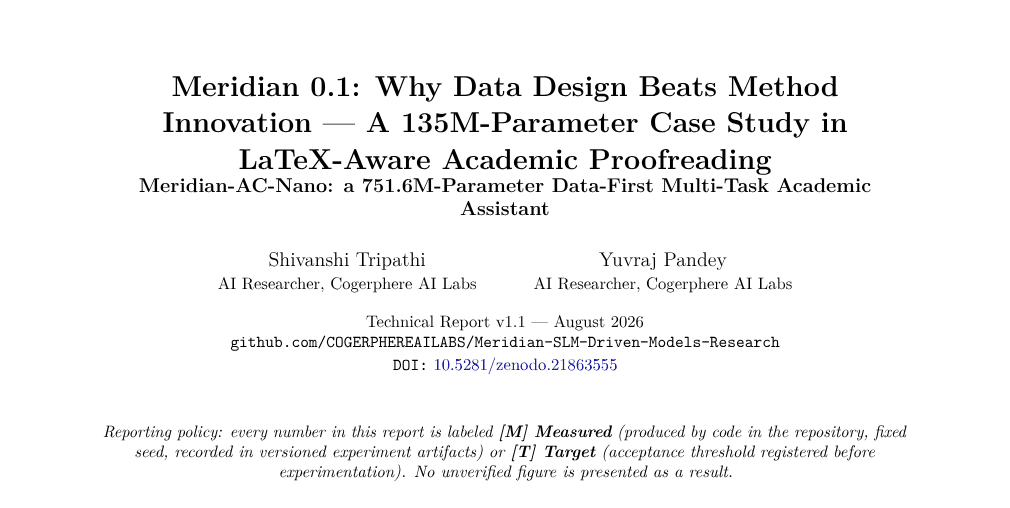
Meridian 0.1 — data design vs. method innovation for a LaTeX-aware academic proofreading SLM
Citation
Pandey, Yuvraj (Researcher) & Tripathi, Shivanshi (Researcher). Meridian 0.1: Why Data Design Beats Method Innovation — A 135M-Parameter Case Study in LaTeX-Aware Academic Proofreading. Zenodo.
Academic proofreading is typically treated as a scale problem: throw a larger model at it and hope the grammar, clarity, and consistency checks get better. Our paper, Meridian 0.1: Why Data Design Beats Method Innovation, argues the opposite — that training-data design, task decomposition, and document-structure awareness can deliver substantial gains without relying exclusively on larger architectures.
Meridian 0.1 takes a data-first approach to academic proofreading using a LaTeX-aware small language model (SLM). The study investigates how the design of the training data, the way proofreading is decomposed into tasks, and awareness of the structure of academic documents each influence final proofreading performance.
Meridian-AC-Nano
The centerpiece is Meridian-AC-Nano, a 751.6M-parameter multi-task academic assistant designed around structured academic text and LaTeX-aware processing. It is built to handle academic workflows — proofreading, manuscript preparation, and LaTeX writing — rather than casual chat.
Inference is designed to run locally on researcher hardware rather than through cloud APIs, so drafts, notes, and manuscripts never need to leave the machine. That is the same privacy philosophy behind Openbentt, where Meridian is intended to ship first.
What the paper covers
- System design — the architecture of Meridian-AC-Nano and its multi-task structure
- Dataset strategy — how data design shapes proofreading outcomes
- Training methodology — task decomposition and LaTeX-aware processing
- Evaluation framework — how proofreading quality is measured
- Limitations — an honest account of the approach's boundaries
The core hypothesis
Improvements in data design and task formulation can provide substantial gains without relying exclusively on larger model architectures. Meridian 0.1 is our evidence that this holds for real academic proofreading workloads — and a template for how small, focused models can outperform their size on structured text.
Authors & records
The paper was authored by the Cogerphere research team: Yuvraj Pandey (Researcher) and Shivanshi Tripathi (Researcher).
- Zenodo record: zenodo.org/records/21863555
- DOI: 10.5281/zenodo.21863555
Published research
Read the full report — methods, corpora, ablations, and deployment details — on the Meridian page, on Zenodo, or explore the research behind Cogerphere's local-first systems.
Model · August 2026 · 6 min read · Paper · By Yuvraj Pandey & Shivanshi Tripathi — Cogerphere AI Labs.
← All posts